02.26.2026

Note: This blog is written by a survivor of gun violence and contains references to being threatened with a firearm. Please take care while reading.
As a student in the United States, I’ve always known the danger of gun violence.
I remember walking into my house after school on a December day in 2012. My mother was crying and thanking God that I was okay. As the evening unfolded, I was utterly shocked and confused as we listened to news reports stating that 20 children and 6 staff members had been shot and killed at Sandy Hook Elementary School.
At the same time, I was growing up in a place where gun violence was already woven into everyday life — something we heard about through word of mouth because it rarely made the headlines. In many ways, it felt strange to realize how accustomed we had become to that reality.
My years in school continued to be marked by devastating shootings at schools, malls, and houses of worship, and back home in Jacksonville, nearby incidents of gun violence even prompted my school to go into lockdown. And after gun violence directly impacted my family while at a movie theater, I knew I had to do more to get involved in the gun violence prevention space.
Get Help
Support for Teens and Young Adults:
— Love Is Respect offers teen and young adult-specific support related to healthy relationships and dating abuse. Text “LoveIs” to 25522 or call 1-866-331-9474 to connect with an advocate. Help is free, confidential, and available 24/7.
Support for Anyone Experiencing or Concerned About Domestic Violence:
— If you or someone you know is experiencing domestic violence, please contact the National Domestic Violence Hotline by calling 1-800-799-SAFE (7233), texting “START” to 88788, or chatting online at thehotline.org. Trained advocates are available 24/7 to provide free confidential support to people anywhere in the US. You can also find more resources on legal assistance in English and Spanish at WomensLaw.org.
— Access the Everytown Support Fund Resource Guide for Survivors of Domestic Violence and Intimate Partner Violence. (Note: PDF opens in a new tab; it does not automatically download.)
My sister and I were at a movie theater when her ex-boyfriend pointed a gun at her. Many people in the movie theater jumped on him, giving my sister and me time to run to the car. This was my first time ever seeing someone carry a gun and point it at one of my loved ones. That experience also drove home the way domestic or dating violence can intersect with gun violence.
Both teens and adults can experience dating violence. That violence can be emotional, verbal, physical, and/or sexual. Dating violence at any age can have both immediate and long-term consequences.
Teens who experience dating violence can have higher rates of depression or anxiety, substance use, or suicidal ideation. And when teens experience violence in a relationship, it can be a significant predictor of going on to experience domestic violence or intimate partner violence in adulthood.
Read more about the intersection between teen dating violence and gun violence.
I’m grateful that my sister and I made it out of the movie theater on the day her ex-boyfriend threatened her with a gun. But the fear and trauma we experienced in that moment continue to affect our lives. And I know that we’re not the only ones who continue to feel the aftereffects of gun violence.
“I don’t always know how to label myself and my experience with gun violence. I just know that I want to be someone who speaks up about gun violence prevention.”
— 2026 Everytown Student Survivor Fellow
To anyone else who is grappling with gun violence or other trauma: Please know that help is available to talk about it. Processing difficult life experiences is a battle, but it’s not a battle you have to go through alone. Communities like the Everytown Survivor Network can be an incredible place for emotional support and finding connection if you’re not sure where to start.
That’s why I joined the Everytown Student Survivor Fellowship program: to lift my voice and work to end gun violence in every form. The program defines a survivor as anyone who has been personally impacted by gun violence, including by:
- Witnessing gun violence,
- Being threatened with a gun,
- Surviving a shooting, or
- Having a loved one taken or forever changed by gun violence.
One of my main inspirations for joining this fellowship was a previous Student Survivor Fellow. She shared with me how she felt supported by others in her cohort and how much the program helped her share her voice and experience.
Now that I’m a Student Survivor Fellow, I still don’t always know how to describe myself. I don’t always know how to label myself and my experience with gun violence. I just know that I want to be someone who speaks up about gun violence prevention.
If you also want to be part of the gun violence prevention movement but don’t know where to start, that’s okay! Let whatever emotions you’re experiencing stir in you, then use them in a positive way. Some ideas of where to start:
- Have a one-on-one conversation with someone you trust about gun violence in America
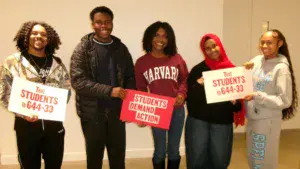
- Join (or start!) a Students Demand Action group at your school or in your community
- Talk to your school board or other local leaders (like your mayor) about passing a secure gun storage resolution in your community
Whether you’re a survivor of gun violence or an advocate who wants to make a difference, let this message serve as a positive energizer for you: Together, we can create a better tomorrow as we work to end gun violence.
2026 Student Survivor Fellow
This blog was written by a 2026 Student Survivor Fellowship cohort member, who chose to remain anonymous due to the sensitive nature of their experience with gun violence.